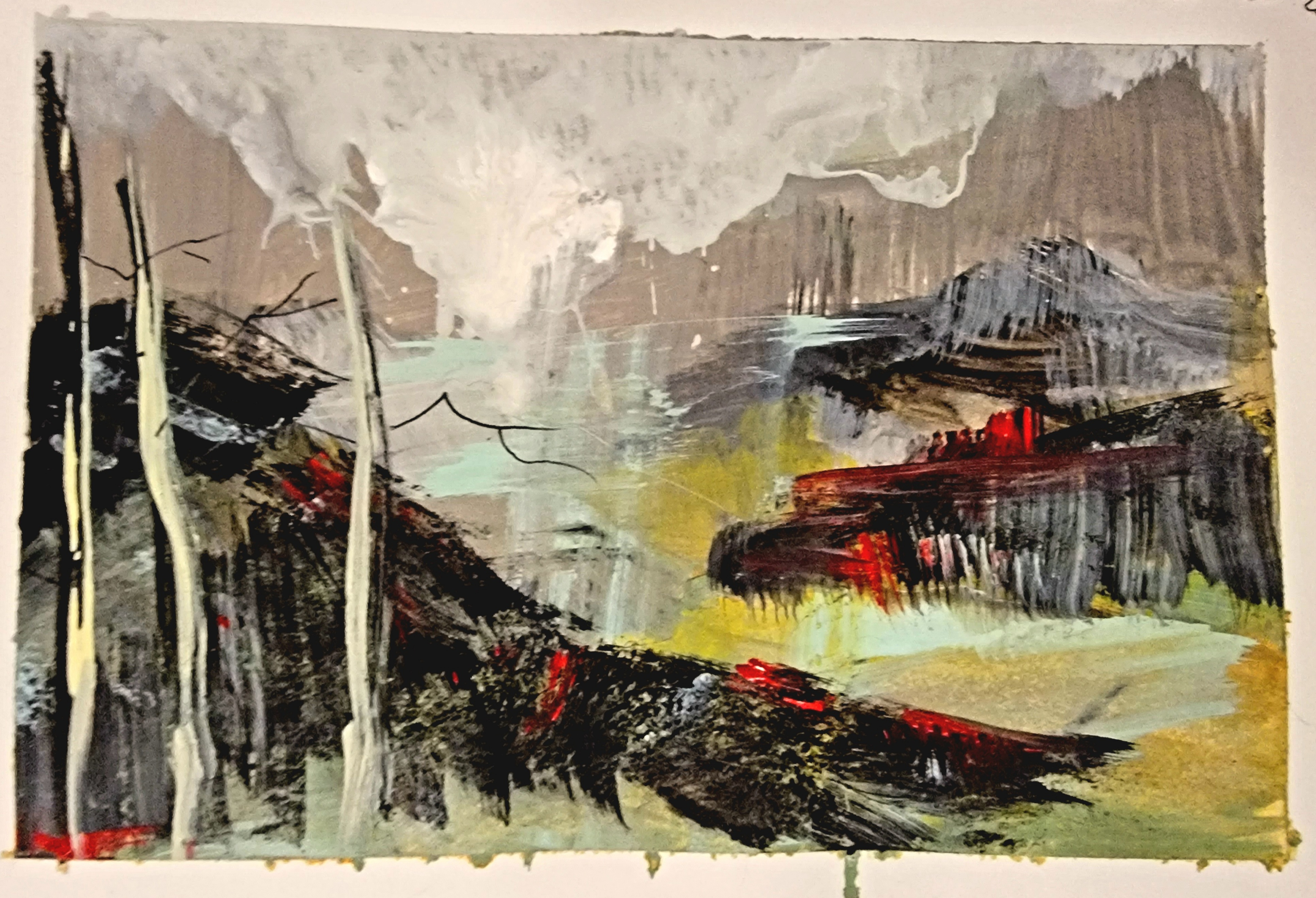
I’ve been working on a series of existential landscapes lately, trying to find more freedom to explore a connection between landscape and mindscape through color and form. (Abstract is always strangely more difficult than realism to get right, even though most people who aren’t artists reasonably assume the opposite. So this is a rewarding struggle.)
This piece is an iteration of events out West that have been haunting the back of my mind for quite some time now. And it takes some backing up for context. So here is the story on this piece: I was in a forest fire as a child, and will never forget the terror and, of all things, the colors. The strange and billowing skies, the weird disappearance of the light, the surreal landscape that is suddenly no longer familiar, and holds no safe place except Out of This.
I grew up out on the Left Coast of Turtle Island, so I have memories of Smokey the Bear and stern warnings about making sure one’s camp fires are out. And yeh, every year the Santa Ana winds have burned through the wealthy canyons of Southern California, for as long as any of us can remember. So fires (and earthquakes) are just part of the Pacific coast mind- bubble. Even so, great conflagrations in the forest were a relatively rare occurrence. As I said, I have a vivid personal memory of only one of them from my entire childhood. Only one.
These fires are no longer rare. Half of the dozen largest fires in all of recorded history have happened since the year 2000. The year 2020 was the hottest in recorded history in Australia, where 42 million acres went up in unstoppable flames. Climate change is real, extreme, and breathing down our necks now. It’s no longer some imaginary thing way off in the distance: it’s here. Now. And it’s terrifying. Temperatures are rising, glaciers are melting, summers are drier, and the world is on fire.
Most of my family still lives on the west coast, and for the past 5 years in a row I have had people I care about fleeing devastating fires in one city or another out there – increasingly in more than one city and/or state at the same time. The air is so thick with smoke out west now, every summer, that lung and heart disease risks are skyrocketing. Entire towns are burning to the ground. Just in 2020 alone, more than 7 million acres burned in the United States, and tens of millions of acres burned across the globe.
This is not the world I grew up in. Yes, I do remember that forest fire. That ONE fire. But now, these conflagrations are an annual cycle, and they are getting bigger. I cannot overstate the dramatic impact this is having upon real people’s lives.
My parents live in the Cascade mountains of Oregon, where they have lived for more than 40 years. In all of that time, until a few years ago, fires were something one just heard about every now and then in the news. Suddenly, they are a clear and present danger causing very real terror, each and every year. My parents keep “bugout bags” packed at all times now. They have a small trailer they keep important and cherished things in, ready to go, “just in case.”
This isn’t paranoia or extreme caution; this is just how it is now, out west. I’ve come to regard such meaures as a basic survival skill out there, particularly after a cousin endured having her home and everything in it burn to the ground in California one year, after being evacuated without a moment’s notice.
In 2020, the woods caught fire in the hills near my parent’s home, and they spent anxious days and nights listening to forest service updates, worrying over what to do. Fire fighters were unable to contain the flames, so my parents and all their neighbors were ordered to evacuate from their homes, and there was quite literally nowhere for them to go. It was the middle of the pandemic, and the entire west coast was on fire. The air was black and toxic for hundreds and hundreds of miles. There were spreading and uncontained fires in every western state.
Under orders from the forest service, they left their home, initially planning to stay with friends in Oregon City, many miles away. But it turned out, their friend’s home was also in the path of smoke and fire. Exhausted, they were forced from one little town to another. Everywhere they went, the air was thick with smoke and the flames were everywhere. They found no relief anywhere, until they finally settled into a motel room on the edge of the Columbia River, up on the Washington border, to wait out the flames for more than a week. Even there, hours from their imperiled home, the air was filled with smoke and there were questions as to where the flames might break out next.
I remember anxiously trying to navigate this trek with them from my apartment in New York, and when I checked the fire map it showed nothing but red flames from southern California all the way up to Canada, and from the Pacific ocean to the Rockies. My heart raced from all the way across the country, so it is hard to even imagine the panic going on back in Oregon.
At the same time they were escaping the flames, friends of mine who live several towns away, in Estacada, were having to evacuate hundreds of farmed animals from the farm sanctuary they run, in the middle of the night. They were getting the last of the pigs, sheep, chickens and horses out in volunteers’ trucks at around 3am. What a nightmare.
My family’s home managed to survive the fire, but every summer and autumn now, they live with that little trailer packed full of “bugout” essentials, anxiously listening to fire reports and praying for rain.
So that is some of the context as to why forest fires have made their way into my paintings at least half a dozen times now. It’s a thing that’s on my mind a lot, especially in warmer weather. This particular piece has to do with one of the fires that raged, in the past few years, through the forests of my childhood.
In the fall of 2017, a teenage boy throwing fire crackers lit the Columbia Gorge on fire at Eagle Creek. It had been one of an increasing string of hotter, drier summers, and maybe in a pre-anthropocene year this would not have happened. But in the summer of 17, it was so hot and dry that forest service graphics were dialed up into the red and nobody was supposed to be playing with fire anywhere. This dumb kid and his friends did not get the notice, and the fire they sparked off burned at least 50,000 acres and could not be contained for months. It was still smoldering late into the spring of 2018.
This was a forest I grew up in. I had hiked the very trail that stupid kid threw the fire crackers on, at least a hundred times. It smelled like ferns and larch trees, and sounded like birds when I was a kid. I remember a time when friends of mine fought nails to save that forest from the viciously foolish saws of the timber industry. One person even died to save that forest. When I went back west in the summer of 2018, surveying the damage with a friend’s drone, it was all reduced down to blackened carbon – thousands and thousands of acres of black, charred, devastation. There is a smell that comes with a fire that isn’t like anything else. Everything had that smell. I can almost still smell it, clinging to my skin.
It was the worst fire in many local memories. And then, with the next year, came another series of fires even greater than that one. And again the next year. And the next. And the next.
Honestly? God DAMN the climate change denials, the useless hand- wringing of oil company executives, and all those useless bumpkins who hollered for years that this was not real.
So anyway. That’s what this painting is all about.

 Beyond the Barbed Wire