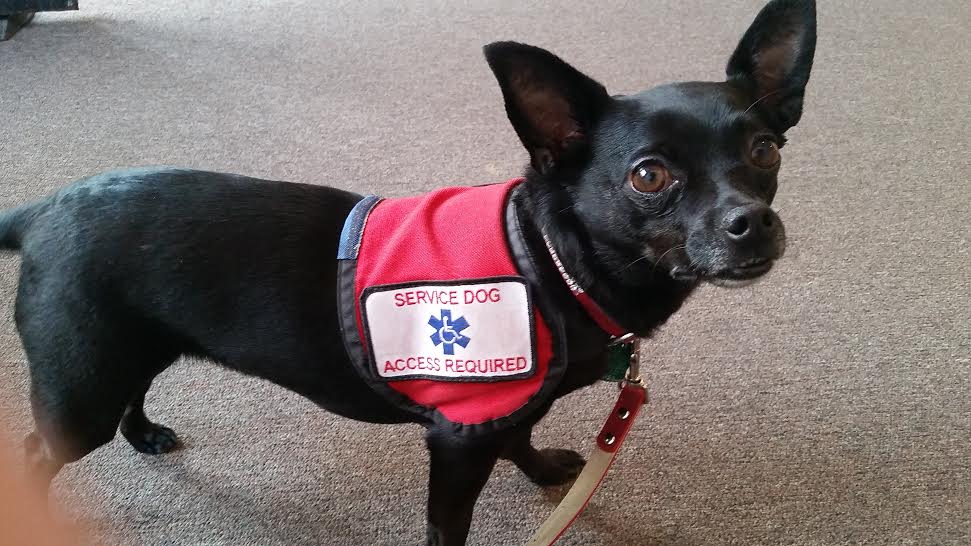
 By Cat Jones
“You can always tell a fake service animal because the person gets so mad when you question it,” said the man in the comment section. “Why do they always have to be so angry about it,” agreed the woman. If this is you, or if you’ve found yourself saying crap like that, maybe I can help you here. Let me explain what it’s like to be a person with a disability who is assisted by a service dog.
I’ve written before about what it’s like to be hassled for having a service dog. But it just keeps happening, so I need to say something more about this. Lately, everywhere I go, people keep asking for “paperwork” on my dog, and trying to deny us access when I refuse to provide it. Let me just say now, that is illegal. Yes. So is asking me why I need her, or anything about my medical condition or history. It’s not just illegal, it’s rude. (Would you want a complete stranger demanding “papers, please” or asking you personal questions about your medical history and diagnoses? No. Me either.) As I like to tell the people who ask me these things, this is the law under the Americans with Disabilities Act, and please read this if you have any questions.
You may ask me whether my dog is a service animal, and you may ask what service she provides. That is all. If my dog is disruptive or misbehaving, you may ask me to take her outside, service dog or not. That will not happen, as she is well trained. So you are protected, and so am I, by the law.
No, the Health Department isn’t going to shut you down for allowing my dog in your restaurant without “paperwork,” even though many people try to tell me this when I refuse to produce an ID card or paperwork on my dog. Do you know why the health department isn’t going to bother you about my service dog? Because they know the law, and so should you. The Americans with Disabilities Act (ADA) is clear on this point. My dog does not require special identification for you to inspect, and she and I are allowed access anywhere that the public is normally allowed to go. You cannot exclude us, you cannot harass us, and you cannot subject us to a barrage of time-consuming, personal, and harassing questions,
“But what about fake service dogs,” I was recently asked. Yes, what about them? After the New Yorker published a ridiculous screed about a year ago decrying the alleged scourge of “fake service animals,” people seem to feel entitled to grill me about my dog, particularly since she is small and doesn’t fit the stereotype. Other outlets picked up the meme, and suddenly articles on alleged fake service dogs were everywhere, giving everyone a sense that they are entitled to question every service dog team. However, it turns out that almost all of the articles are coming from one source: An organization called Canine Companions for Independence, that breeds, trains, and sells service dogs. Their CEO has been quoted as saying he has “declared war on fake service dogs,” and has made it a mission to require that all service dogs be officially certified – for a price- from an agency like, well… his. So there’s some unexamined self interest going on in the fake hype around fake service animals.
In reality, though, so called “fake” service animals are not some new epidemic, and the only people actually harmed by them are people like me, who now get hassled everywhere we go because of that hype. (I do need to be clear, to anyone reading this who fakes it that, that it’s both illegal and extremely ableist to pretend you need a service dog when you don’t, and these untrained dogs are distracting to real service dogs like mine. Indeed, if you fake a disability and try to pass an untrained dog off as a service animal, you really are a douche. But that’s between you and me, your shitty rotten conscience, and the enormous fine you’re going to get for mindlessly appropriating other people’s suffering. Everyone else? You’re NOT helping by hassling and harassing ME.)
Ironically, if someone actually does show you ID or “paperwork” on their dog, it is much more likely to be a fake service animal than someone who refuses. Those of us with real service dogs know the law, and we know that there is no such thing as a “registry” for service animals, and there is no “paperwork” to prove that they are service animals. Any ID or “paperwork” was likely ordered online, and that may or may not indicate the dog is not really a service dog. I, myself, actually do carry cards for those occasions when I absolutely must have access and some asshole gatekeeper refuses to allow me in without ID. But I ordered the cards online, and so could anyone else. (Don’t be an asshole, though. Faking it is illegal and people with real service dogs can spot you from space.)
I generally refuse to provide these cards, and if I do I always take the time to explain the law first. I do so because, otherwise, the next person who is assisted by a service dog could be denied access on the grounds that “this other person showed me a card so why wouldn’t you.” That really is a thing. You might think I’m being rude by refusing to pull out the fake credentials I had to buy online just to appease you, but my allegiance is not to the bozo gatekeeper who wants to able-splain the ADA to me without knowing what they’re talking about; it is to other people with disabilities who don’t need the added burden.
In point of fact, a service dog needs to be well trained and not a nuisance, and ANY dog, service or not, can be excluded if she or he is barking, growling, menacing, pooping on things, or whatever. So if the dog is well behaved and calmly hanging out with her or his handler, and if the law allows you to have the animal in your business because you asked if it was a service animal and were told yes, then why bother the dog or the handler? If it craps under the table or tries to bite another customer, send it out. Otherwise, leave it alone.
 You know what a much bigger issue is than accidentally allowing in a fake service animal? Denying access to a real one.
Here’s why this is a big deal to me.
I have had a service dog for many years. The reason, while it’s not really anyone’s business but my own, is that I struggle with a very disabling mental health disorder that I’m pretty frank about. It involves, among other things, an extreme amount of anxiety about being in the world at all. No, I don’t mean I’m a little anxious so I bring my dog everywhere like a teddy bear. I don’t mean normal human anxiety, and neither should you – you don’t get to call your dog a “service animal” just because you get anxious just like everybody else. What I mean is that I suffer from severely disabling OCD, that would have put most people into an institution by now. (No, I’m not a clean freak or a germophobe or whatever other stereotype social media is selling on this point.) It is what it is. My service dog allows me to function normally in the world in ways I otherwise might not be able to do. I don’t really like to go into all the ways she helps me, because it embarrasses me and reveals more about my medical condition than I like to. The long and short of it is, I have her with me because going out into the world is hard for me, interacting with people is hard for me, and I need to do these things anyway. (*See footnote. To be clear, my dog is not an “emotional support animal,” but an actual service dog. See below for clarity.)
So when you stop me at the doorway and single me out in front of other customers to challenge me on my right to be there with my dog, you are embarrassing me. You are making me feel all of the things that someone already struggling with as many obstacles in their way as my disability has put into mine does NOT WANT TO BE MADE TO FEEL every time I go out in public. Do I seem upset and angry when you challenge me like this? It’s probably because I have been forced to explain the law to virtually everyone I have come across today, and I am TIRED of it. It’s probably because 9 times out of 10, no matter how politely I try to explain the Americans with Disabilities Act to people like you, they don’t believe me and continue to argue with me. It’s probably because I keep getting embarrassed, humiliated, and denied access to public venues because people do not bother to understand the law. (Talking to YOU, Tess Collins, of McGearys in Albany New York.)
I’ve tried for YEARS to be patient, but after awhile, I just want to fucking go out to eat and not have to walk through a gauntlet to get to my table. Maybe I just want to buy a freaking jug of orange juice and don’t WANT every staff person in the store chasing me down the aisles and telling me I can’t have a dog in there (talking to YOU, Cherry Valley Marketplace in Brooklyn). Maybe I just want to sit down for a few drinks with a friend and not be harassed and intimidated or, in one especially egregious case now in litigation, I don’t deserve to be ASSAULTED by an idiotic bouncer as I’m paying my bill on the way out (talking to YOU, Cafe Hollywood). In other words, maybe I want to do the same things you do, and I do not want to be hassled for it any more than you do.
Please understand, just because my dog is small and cute does not mean she is not a serious service dog doing important and legitimate work. Please also understand, I probably don’t want to have to talk to strangers about my diagnosis everywhere I go. I also don’t want you distracting my dog by making noises at her, reaching for her, trying to feed her, or any of the other weird things that well-meaning people do when we are out in public. She’s working, and needs to focus on her job. She does not like to have strangers sticking their hands into her face any more than you or I would, and I swear the next person who loudly barks at her is gonna get drop kicked. (WHY is that a thing?!)
Here are some resources for people who want to understand the proper way to interact with a service dog team:
http://www.canineprofessionals.com/service-dog-etiquette
http://www.anythingpawsable.com/10-things-service-dog-handlers-want-know/#.VkH4aPldWSo
Please understand, it isn’t just once or twice that people bother me about my dog. It’s virtually everywhere we go. Any time I want to go into a new place, I have to pause outside the door and ask myself whether it’s worth the struggle I will probably encounter just inside the doorway. Even places where I have gone successfully before can suddenly become unfriendly and intimidating with a change of staff. It’s hard enough for me to go out into the world, I just don’t need this. Please educate yourself, your friends, your staff. Please help me to spread the word that service dogs come in all sizes and shapes, that the law requires that they be granted access, and that no one has the right to grill me about whether or not she is a “real” service dog any more than anyone would be entitled to grill someone who uses a wheelchair or crutches. Please respect the civil rights of all people with disabilities, whether those disabilities are visible ones or invisible ones.
 * Although I have Ruby with me due to OCD and anxiety issues, she is not an Emotional Support Animal (ESA), which is a different thing under the law. Unlike an ESA, my dog is a psychiatric service dog, trained specifically to assist with my disabilities in many different ways throughout the day. An ESA, on the other hand, is not required to be trained at all, and their purpose is simply emotional comfort. They do not have the same access rights as a service animal.
If you have an issue with a psychiatric service animal, or take issue with the fact that mental illness is just as much a health issue, and can be every bit as disabling as any other health issue, or you are under the erroneous impression that people with psychiatric service animals shouldn’t be allowed the same rights as people with any other kind of disability? Tough. Die mad about it. 😉
 Beyond the Barbed Wire
We are sad and angry that you continue to experience such stress when you take your dog with you. You speak up eloquently for service dogs and for the people who rely upon them.
I empathize with you and the anxieties you have which requires that you have a service dog; however, I would like the same respect and empathy for my problem which is an abject fear of animals, especially dogs. I respect those who have an actual “service dog” and I can sort of keep myself together if it is a real trained service animal. That doesn’t mean that I can stand by you in a line of any kind, example, TSA scanning line at airports, or be in a crowd where I come upon an animal which is within touching distance; therefore, I don’t usually go to those kind of affairs. I have had to give up flying because there is no way I can sit and stay in my seat if there were to be animals allowed to sit in the lap of a seat mate or in front or behind me. I had one experience where I kept hearing a dog and it turned out to be under my seat. I had a hysterical meltdown that I could not control, first, my screams upon learning of a dog under my seat, and second, my sobs and shaking once the flight attendant moved me to the front of the plane. Don’t anyone worry that this was a way for me to be upgraded to first class. It was SWA which doesn’t have first class.
This year, I have driven from Texas to Kansas (twice), Atlanta, GA, and Myrtle Beach, SC for professional meetings because it seems everywhere I go there is a dog.
Dogs are in Macy’s (on a leash but no one holding the leash); Home Depot, Lowes, a small antique store, just the other day, Sam’s Club, Grocery Stores, and, no thank you, I do not want to put my groceries into a cart where you have placed your dog while you were shopping.
I am past the age where I can run or outrun a dog. It is a time when I have to call or watch before I go into any public place.
Again, I can sort of deal with real service dogs, plus if their owner knows about my phobia, they usually try to watch out for me while I watch out for their dog.
Perhaps the ADA needs to declare that my phobia is disabling to me and give me some rights, at least, as good as the animals and their owners.
I will be driving to New Orleans soon because I cannot fly with the animals people are bringing on planes.
Jessie
Jesse,
It does sound like your fear of animals may indeed be disabling at this time. Thankfully, phobias like yours are easily treatable through exposure therapy, and it sounds like you would benefit greatly from a qualified therapist. Meanwhile, there are a few important points to be made here, which will hopefully clarify to you that my use of a service animal has little to no negative impact upon you, so that this concern cannot and should not be misconstrued as having any bearing upon my right to be in public with my service animal.
First, any time you are out in public, you’re likely to encounter many, many animals. On any given day, 90 to 100 percent of those animals are *not* service animals. You cannot walk down a public sidewalk, visit a public park, or often even go to someone else’s home without the likelihood of encountering a dog or cat, and very, very few of those animals are likely to be service animals. A number of the public businesses you’ve named allow dogs regardless of whether or not they’re service animals, and the vast majority of dogs you will encounter in a given month are *not* service animals.
Second, concerning your comment regarding grocery carts: in the first place, my dog does not ride in a grocery cart, and few other service animals do either. In the second place, the same could be said for having to use a cart previously used by a human baby. In fact, there are far more transmissible germs on the spittle and other leavings of a human infant than you will ever encounter from a dog. That doesn’t give anyone the right to ban babies from carts. But again, most of us don’t have our dogs in your grocery cart.
Finally, and most importantly. As I said, if you’re being honest about the severity of your animal phobia, then it does indeed sound as if you are suffering from a disability on account of this phobia. If that’s the case, then avoidance is not only *NOT* a solution, it would actually increase your level of disability. Medical science is very clear on this point. Phobias are quite treatable, and the most effective treatment for a phobia is exposure therapy. In other words, repeatedly exposing you to the thing you fear is the way to freedom from that phobia. Correlationally, avoidance will only make the fear worse, and can turn an ordinary bit of anxiety into a disabling condition. Absolutely the worst thing you can possibly do for a phobia (or panic attacks, for that matter) is to practice avoidance.
Here are a few articles to explain this for you:
https://www.anxietycanada.com/adults/avoidance
https://www.healthyplace.com/other-info/mental-health-newsletter/avoidance-helpful-in-a-moment-harmful-to-mental-health
http://www.anxietyguru.net/why-you-should-not-practice-avoidance/
So I’m sad that you are struggling with this disability and I hope you find a good therapist who can assist you with it. In the meantime, please do not ask or expect people with service animals to stay home to “protect” you from this fear, as that would not be helpful for you OR for me.
Regards,
Cat
[…] ignorance and hostility on account of my service dog. Indeed, I have written about this issue here and here. But what happened at Cafe Hollywood rose to an entirely new level of […]
[…] used to being harmed by other people’s ignorance of the law, but I did not expect it here. I generally carry a paper copy of the ADA in my bag, for […]
[…] That’s the thing about access denials, they are part of a net of interlocking oppression that creates a bigger disability for me, and people like me, than our actual disability. And I’m going to say, not for the first time, that it isn’t fair that other’s ignorance should be made into my problem like this. If you’re one of the people who has either read or written about “fake service dogs,” and thinks it’s your place to stand in my way for fear of this phenomenon, please read my previous article on this subject. […]